Priced for Perfection
AI speculative mania is in full swing
By: Daniel Rasmussen & Chris Satterthwaite
Investing isn’t a game of analysis; it’s a game of meta-analysis. We can’t predict the future with any degree of accuracy. But market valuations reveal the distribution of other people’s forecasts, and we look for places where optimism or pessimism have become extreme. Mordecai Kurz calls these “correlated beliefs,” places where everyone thinks the same way, causing prices to move into excesses of speculative mania or depressed hopelessness.
Markets are mostly efficient, but we have nevertheless observed several of these “correlated beliefs” emerge over the past decade since Verdad began.
Not long ago, every institutional allocator believed private equity would magically outperform every other asset class and thus merited sometimes a 40% or greater allocation. We were one of the only skeptics, willing to call BS on this growing enthusiasm (see our major article in 2018). Our understanding of private markets led us then to be early in warning of the risks in private credit in 2020.
When others were running for the exits during COVID, we declared in March 2020 on Patrick O’Shaughnessy’s podcast, Invest Like the Best, that this represented the best buying opportunity in public markets since the great financial crisis. The market had formed a correlated belief about an impending depression, and we took the other side.
Sometimes entire countries can be effectively abandoned by investors. After the lost decades, Japan was thought to be dead money. In article after article, we wrote about the pessimism baked into share prices and the real structural reforms that were coming into play.
Our goal at Verdad is to identify these big structural mispricings and take the other side of the consensus, using deep empirical research to lay out the contrarian case.
Today, the market is yet again pricing in an extreme consensus belief, this time around AI and semiconductors. There’s an old saying that, on Wall Street, there are no bad ideas, only good ideas taken too far. That’s exactly what we are seeing today with the AI trade.
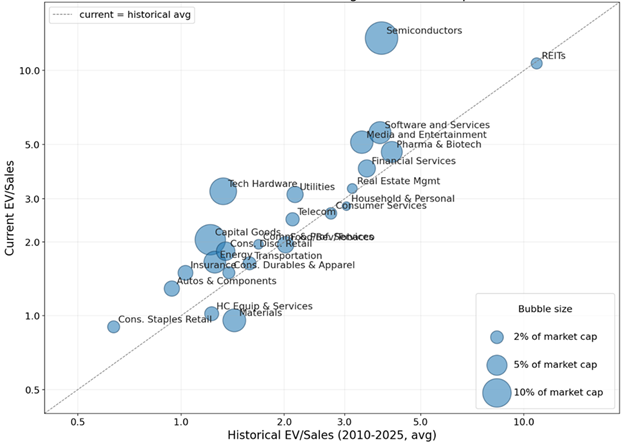
Valuations paint a clear picture of an industry where consensus has passed from optimism to mania. The chart below shows valuations by industry today versus the 2010–2025 average, where the bubble size is share of global market capitalization.
Figure 1: Current EV/Sales vs. Historical Avg. by Industry (2010–2025)
Sources: Capital IQ, Verdad analysis
We are in probably the best market ever for semiconductor stocks, so a premium to the last 15 years is, of course, merited. But this good idea has been taken too far. Investors seem to have forgotten that semiconductors are one of the most cyclical products in our economy. AI has turned tech into a capital-intensive industries, where competition neglect is likely to cycles of capacity overbuilding and subsequent crashes.
The market consensus story is that this time is different. “AI is behaving more like foundational infrastructure,” writes one major investment bank in an attempt to address bubble concerns. “AI breaks that template. It is not a discretionary upgrade or a consumer gadget cycle. It is infrastructure, embedding itself directly into the productive capacity of the economy in a manner closer to electricity than consumer hardware.”
Investors are taking a massive bet that this theme is right. But we won’t know for years what the return on investment of this AI spend will be. Return on capex spend is every bit as unpredictable as growth rates. And the risk is that, even if the technology fulfills the promise of the optimists, the amount of spending today could yet overbuild, just as internet companies overspent and overbid in the late 1990s and early 2000s. When Alphabet, Amazon, Microsoft, Meta, and Oracle combined are guiding for $775 billion of capital expenditures in 2026 alone (a little over $2b per day), it doesn’t seem difficult to identify a correlated belief system.
The challenge with bubbles is not that they overstate the ultimate transformative benefits of a technology but rather that they price in many of those uncertain transformative benefits as if they are a given today. As a result, valuations expand, with much of the present value of equities embedding discounted cash flows far into the future, where they are clouded in uncertainty.
This is especially delicate, considering that the half-life of this spend is quite short relative to previous technological capex cycles. On its Q1 2026 call, Microsoft noted that two-thirds of the capital expenditures went to short-lived assets like CPUs and GPUs, which have a useful life of 3–5 years. The global stock market is now running on a very fast hamster wheel, with no margin for error. In a few years, only a small portion of the capex will go toward new assets. The balance will simply go toward replacing the obsolete chips from 3–5 years ago.
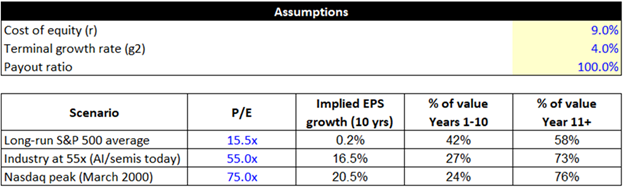
The global semiconductor industry currently trades at ~55x P/E in aggregate. Instead of asking what the industry should trade at, we can turn the question on its head: What does a 55x multiple imply about future expectations? Courtesy of Michael Mauboussin and Alfred Rappaport’s Expectations Investing framework, at 55x we can infer the following about the long-term growth priced into the future of the semiconductor industry.
Figure 2: Implied Growth and Value Expectations at 55x P/E
Source: Goldman Sachs
Roughly 75% of the current value of the global semiconductor industry (13% of global market cap and ~17% of US market cap) is derived from cash flow projections that are more than 10 years in the future (after first compounding at 16.5% for 10 years). A decade ago, OpenAI and Anthropic didn’t even exist. Who is to say what the world will look like in another 10 years? Consider some hypotheticals:
Perhaps AI will design new semiconductors and chips for itself, making the current generation of spend obsolete faster than expected.
Perhaps the race for semiconductors will force enterprising entrepreneurs to come up with clever innovations that invalidate existing supply chains and bottlenecks.
Perhaps software improvements will dramatically reduce the compute required for training and inference of new models.
Perhaps Chinese open-source models will eat away at the competitive advantage of large frontier models in the US, without all the massive compute spend.
Perhaps San Francisco will be hit by the “Big One” and much of the world's AI talent will fall into the sea.
Perhaps datacenters in space will solve everything.
Most of these outcomes may be unlikely, but that is beside the point. The point is that current valuations embed a certainty that the world will unfold according to the most rosy projections that analysts can conjure for an exciting new technology, precisely at a time when uncertainty is highest.
The biggest bulls in a bubble create a false dichotomy, accusing skeptics of lacking imagination or being blind to the transformative power of new technologies. Bears often spend too much time trying to draw specific analogies to historical crises or looking for the eventual catalyst, which often arrives in the form of an otherwise innocuous update, like the lowering of capex guidance. But timing the burst of a bubble is exceptionally hard. Bubbles can continue to grind higher for an indefinite period of time before ultimately bursting.
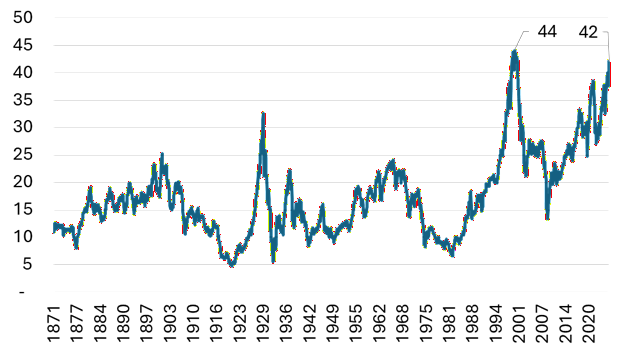
Put simply, bubbles have consistent hallmarks, and they often occur around transformative new technologies. That is precisely where we sit today. With the Shiller P/E Ratio (CAPE) sitting at 42x, on par with the highs of late 1999 (44x), investors are unlikely to be rewarded for taking the risk of underwriting an uncertain future.
Figure 3: Shiller P/E Ratio (Cyclically Adjusted P/E)
Source: Robert Shiller
As we wrote here, those who underwrite the capex (i.e., asset growth) of new technologies tend not to be the ones who benefit most. In general, they overspend, and the benefits accrue to those who come along later and can feast on the bones of the first movers. For investors who are patient, and who believe the world is uncertain, there will be an opportunity to invest in the transformative technology of AI at a fair price at some point in the future. Likely when those who stepped up to fund the first $5–10 trillion of the initial wave of capital expenditures have been steamrolled by some unforeseen development.
The future is too uncertain and unpredictable to make high-certainty bets. Yet today’s market—and today’s largest tech companies—are taking one of the largest bets in the history of economics on the future of a new technology. One does not need to be a bear on the technology itself—we are power users and love AI—to identify that this moment in market history is likely to be characterized by over-investment, over-spending, excessive valuations, and inevitable disappointment as an uncertain future surprises a consensus narrative that is too specific and too confident relative to the pace of change.