Concentrated Co-Investments
Why optimism about co-investing is excessive
By: Brian Chingono and Daniel Rasmussen
The hottest topic in the private equity allocator community these days is co-investment. Co-investments promise everything LPs want from private equity in one package: lower fees, more control, more visibility into the underlying deal, and—most importantly—the prospect of higher returns. Why pay 2-and-20 for a blind-pool fund when you can invest alongside your best GPs, often with little or no management fee and reduced or zero carry, and put more capital behind the deals you like best?
But there is a problem with the standard co-investment pitch. The usual argument focuses almost entirely on fee savings while ignoring the loss of diversification. A co-investment is not a lower-fee version of a diversified private equity fund. It is a concentrated bet on a handful of companies drawn from that fund.
The question, then, is whether the fee savings from co-investment are large enough to overcome the performance penalty from concentration. Our answer is: probably not.
Using the same methodology as our previous article, “Total Concentration,” we simulated 10,000 paired outcomes of PE funds relative to co-investments from those funds. The funds each have 25 holdings and a fee structure of 1.5% management fee and 20% carry. We then randomly select three companies from the fund to represent the co-investment portfolio. The comparison is therefore between a diversified fund net of fees and a concentrated co-investment portfolio gross of fees.
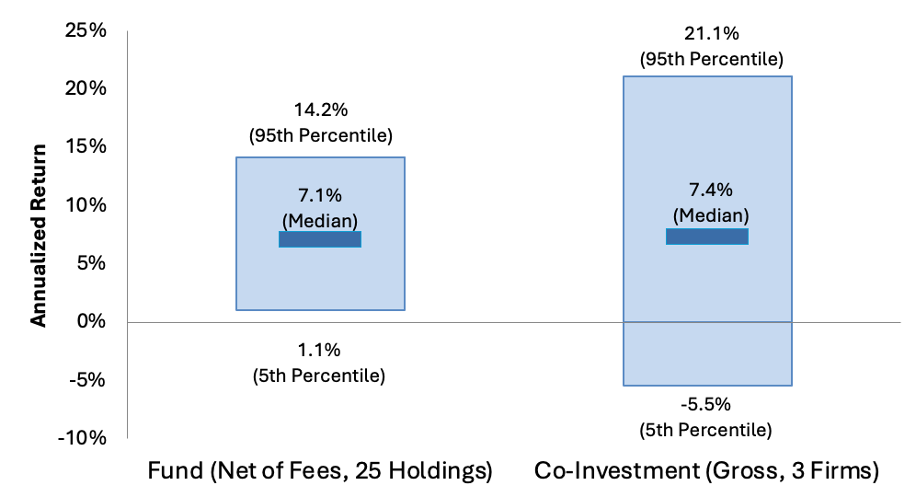
We find that the fee advantage is largely offset by the volatility drag from concentration. The distribution for co-investments is much wider than the distribution for funds: more upside in the best cases, but also much more downside. The median outcome barely improves.
Figure 1: Range of 10-Year Return Outcomes: Funds (Net) vs. Co-Investment (Gross)
Sources: S&P Capital IQ and Verdad analysis
The median fund outcome is 7.1%, while the median co-investment outcome is 7.4%.
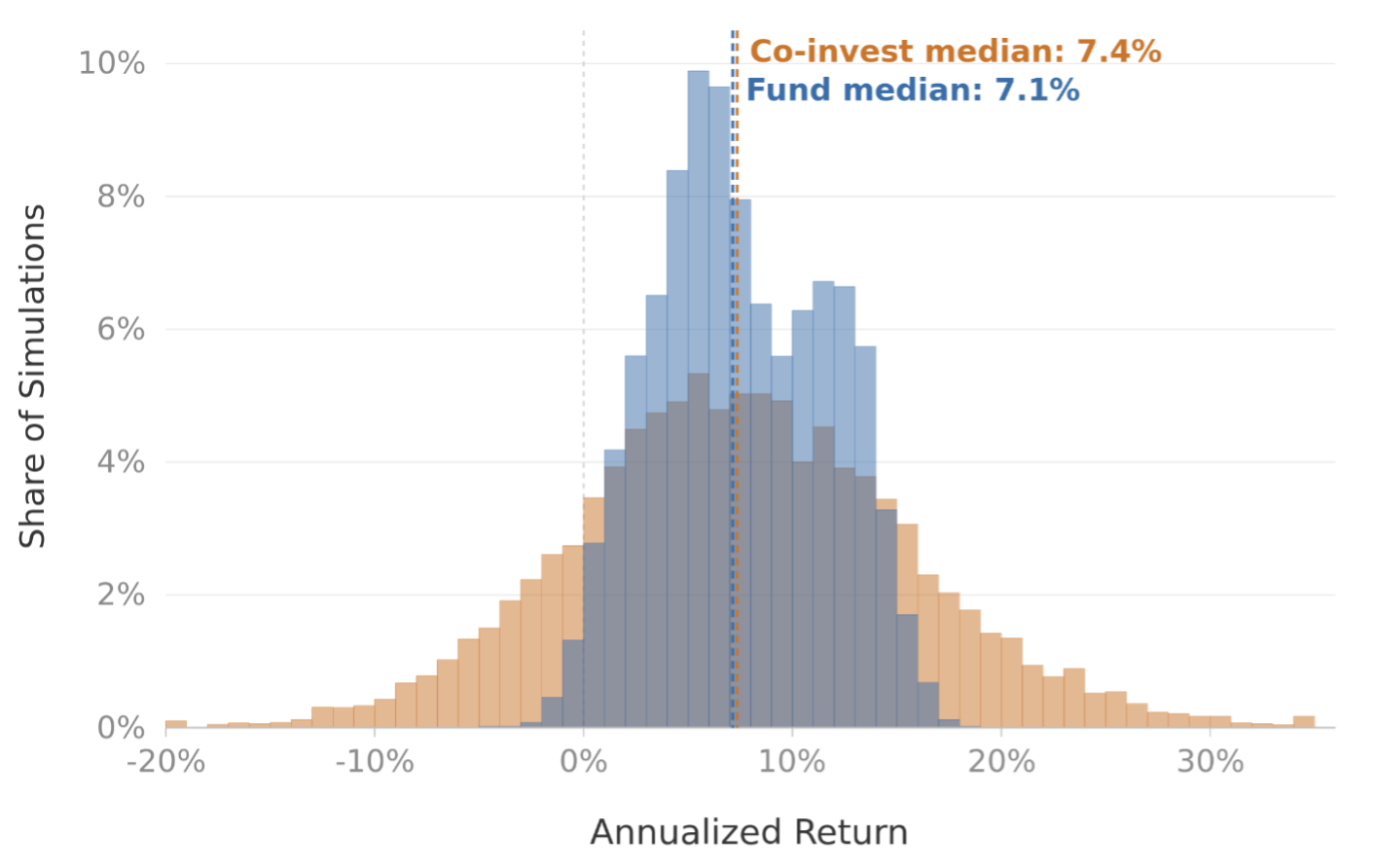
Perhaps it is even more relevant to compare the distribution of performance of the co-investments to the performance of the funds from which those investments are drawn. Despite the substantial fee advantage, we find that co-investments outperform their respective funds only 51% of the time in our simulations.
Figure 2: Distribution of 10-Year Outcomes: Funds (Net) vs. Co-Investment (Gross)
Sources: S&P Capital IQ and Verdad analysis
Allocators with substantial co-investment programs have often found results that look a lot like our simulation. For example, CalSTRS—one of the largest and most sophisticated private equity allocators in the world—earned 15.6% on co-investments versus 12.8% on fund investments over the last 10 years, but only 11.7% versus 13.3% since inception. Allocators frequently speculate about adverse selection in co-invest. We are skeptical private equity firms know which of their deals are better or worse. Our analysis shows that disappointing co-invest results are much more likely to be explained by the loss of diversification. In our simulations, that increased concentration almost entirely offsets the benefit of lower fees.
Co-investments may be the hottest topic in the allocator community today. But lower fees and a seat closer to the deal do not guarantee better compounding than the diversified fund from which the co-investment was drawn. Optimism about co-investments is probably overdone.